
Spring Roof Cleanup Minnesota
Spring roof cleanup Minnesota homeowners plan after snowmelt is best approached as a careful reset of the roof's surroundings and drainage, not a reason to climb onto shingles. Start from the ground, note debris and water-flow concerns, and leave roof-level work to qualified help. Minnesota Roofing Company serves property owners across Minnesota with roofing and exterior services.
Quick answer: Once conditions are stable, clear loose debris from the yard, observe roof edges and gutters from the ground, and check where downspouts send water. Photograph concerns and track leaks or overflow after rain. Do not walk on the roof or remove remaining snow and ice yourself; get professional help for anything that requires roof access.
On this page
Why does spring roof cleanup matter in Minnesota?
Winter can leave branches, leaves, windblown litter, and other debris around the roofline. Snowmelt and spring rain also make it easier to notice whether water is moving through the gutters and away from the building as expected. A seasonal cleanup gives you a chance to remove safe, ground-level clutter and observe how the drainage system behaves.
It is useful to separate cleanup from a full roof inspection. Cleanup means picking up material that has fallen into accessible areas, checking visible outlets, and watching water flow. It does not establish the condition of shingles, flashing, underlayment, fasteners, or concealed parts of a roof. A roof may look normal from the yard while having a concern that needs closer evaluation. A few granules in a downspout or on the ground also do not prove a specific failure by themselves.
Begin with the complete route water takes: roof surface, roof edge, gutter, downspout, and discharge point. If water spills over a gutter, pours beside the foundation, or leaves a recurring streak on siding, record where and when it happens. The company's gutter services page describes the related exterior work. If water is collecting on a low-slope section, its flat roofing page explains that roof type. Information on winter ice-dam concerns may help explain why some conditions become noticeable during thaw.
How can you prepare for cleanup without taking unnecessary risks?
Choose a dry period when the ground is firm and visibility is good. Avoid going outside under a roof edge where snow or ice may still slide. And stay clear of overhead wires, unstable limbs, and areas where a branch could fall. If melting snow has made the ground soft, postpone any work that would involve a ladder or equipment. A cleanup task can wait; a fall or contact with a wire is not worth the risk.
Before walking the property, decide what you can do safely from ground level. Useful items can include work gloves, a small bag for litter already on the ground, a notebook or phone for observations, and binoculars or a camera with zoom. These allow you to see and record without reaching over an edge. Do not use a ladder to get a closer look, step onto a roof, or lean over gutters.
Make the first pass visual rather than hands-on. Look for loose material on the lawn, branches resting against the house, debris visible in an open downspout outlet, or gutter sections that appear to sag. Do not pull on anything still attached to the roof or gutter. If a branch is caught overhead, if an object appears unstable. Or if debris is lodged on a roof surface, keep people away from the area and ask for qualified help.
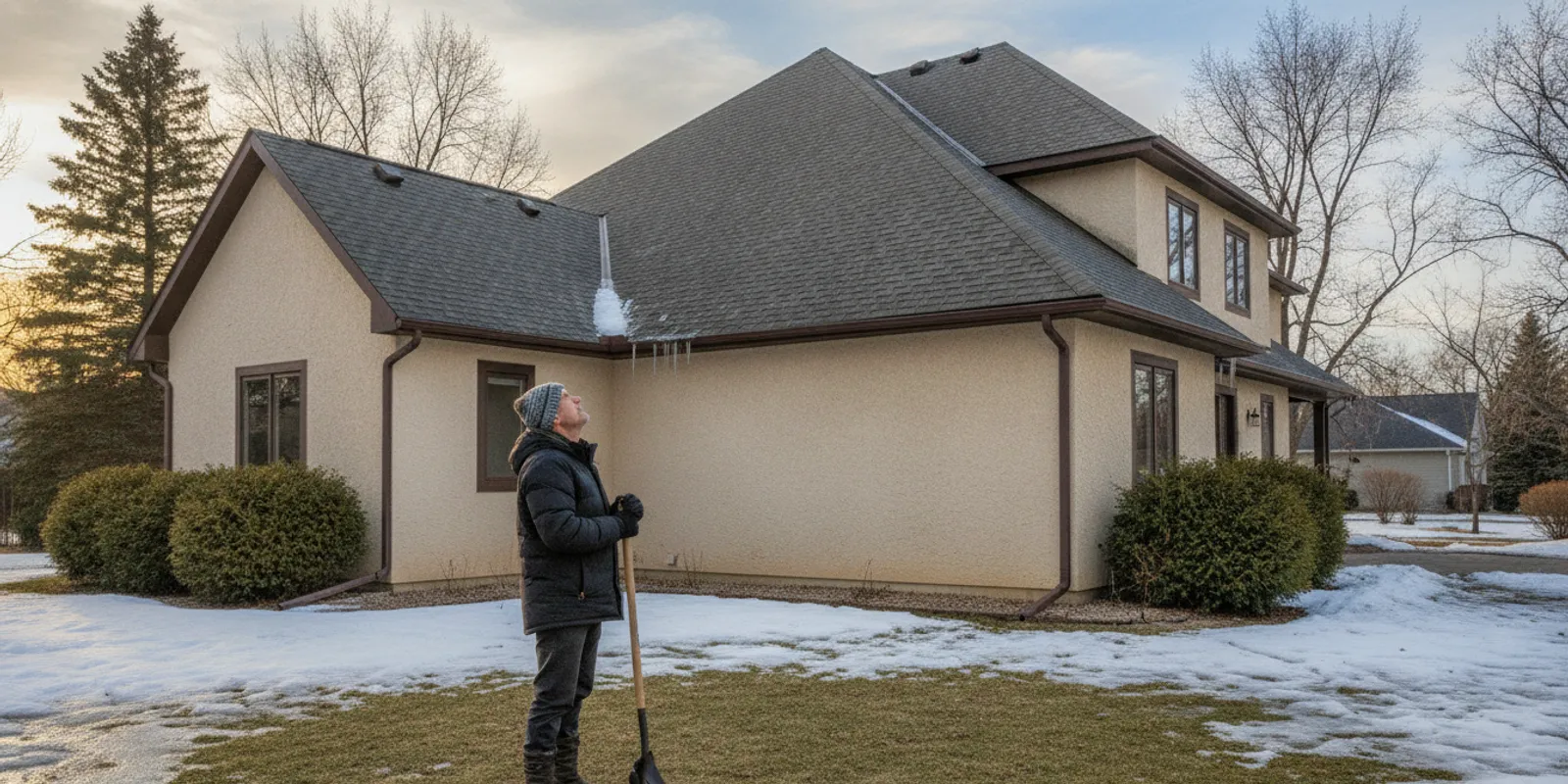
The University of Minnesota Extension cautions that a roof rake or push broom used to remove snow may damage roofing materials. Its guidance on dealing with and preventing ice dams is relevant if winter snow or ice remains: do not treat spring cleanup as permission to scrape or sweep the roof. Leave removal that requires roof access or forceful contact to an appropriate professional.
What order should spring cleanup follow?
A simple sequence keeps the work focused on safe, visible tasks and helps you avoid overlooking drainage. Take one slow circuit around the home, then observe the interior and check water flow during a later rain. If you manage a commercial property or a multi-unit building, adapt the same sequence to the accessible perimeter and report roof-level concerns to the person responsible for maintenance.
- Wait for safe conditions.
Check that the ground is stable and that no snow or ice is actively sliding from the roof. Keep people and pets away from areas below lingering roof accumulation.
- Pick up loose debris on the ground.
Remove fallen twigs and litter only when they are not tangled with wires, sharp objects, or unstable branches. Do not reach onto the roof or into a gutter.
- Look over the roofline from a distance.
Note visible material that seems displaced, uneven edges, hanging objects, or a roofline that appears newly irregular. Do not decide on a repair from a distant view alone.
- Check the drainage route.
Look at visible gutter sections and downspout outlets, then follow the direction of water discharge. Note areas where water would flow toward the building or collect near a walkway.
- Look indoors for new moisture signs.
From accessible rooms, note fresh ceiling discoloration, damp areas, or a musty smell. Do not enter an unsafe attic or disturb wet insulation.
- Observe after rain.
From a sheltered location, watch whether water exits at the downspouts or spills over the gutter edge. Record the location rather than trying to make a repair while conditions are wet.
- Decide what needs follow-up.
If there is active water entry, visible roof damage, a detached gutter, or any concern requiring a ladder, contact a roofing professional.
This sequence intentionally avoids detailed roof-system diagnosis. If you need to understand repair possibilities after noticing damage, review the company's roof repair information and share your observations with a professional. The right next step depends on the actual condition, not on the fact that a cleanup took place.
How should you handle gutters and drainage?
Gutters are a common focus after winter because they collect material from the roof and direct runoff away from the walls. From the ground, check for a section that appears detached, bent, blocked, or uneven. Look at downspout openings you can see without reaching or climbing. A visible blockage at ground level may be removable if there is no hazard. But do not insert tools into a downspout when you cannot see what is inside or where it leads.
Ladder work is not automatically safe simply because a gutter is lower than the roof. Soft soil, uneven paving, wet surfaces, nearby wiring, tree limbs, and the need to stretch sideways all increase the danger. If cleaning requires a ladder, working over an edge, disassembling a downspout, or pulling on a gutter, leave it to a trained person. Do not lean out from a window or use a pressure washer against roof or gutter materials.
Watch the system during rain rather than testing it by spraying water from a ladder or hose. Notice whether water runs out of the outlet, spills over the gutter, drips at a connection, or lands close to the foundation. A small puddle immediately after a heavy shower may not identify the cause; note whether it repeats and where the water came from. Also look for soil washed away beneath an outlet or a wet streak on siding. For related exterior considerations, see the company's page on siding services.
Keep in mind that gutter performance is only one part of drainage. Downspout extensions, grading, and hard surfaces can affect where runoff collects. Do not make a major landscaping change based on a single observation. Instead, take a photo during or shortly after rain and note whether water appears at the same location on more than one occasion. That record makes a later conversation more specific.
What can a cleanup observation tell you, and what can it not tell you?
A visible sign is a starting point for follow-up, not a diagnosis. For instance, water spilling over a gutter during one storm could reflect debris, a drainage issue, or a temporary flow condition; the observation alone does not identify which. Note the exact section, whether the outlet is flowing, and whether the same pattern happens again. If overflow repeats or the gutter appears loose, report it instead of trying to adjust a high section from a ladder.
A damp ceiling mark also needs context. Record when you first saw it and whether it changes after rain or thaw. A mark that stays dry may still deserve attention if it is new, while active dripping calls for prompt help. Do not poke a ceiling, remove wet materials, or enter a confined or unsafe attic to search for a source. Keep clear of water near electrical fixtures and focus on immediate safety.
Likewise, branches or leaves resting on a roof can be difficult to judge from below. A small object may be harmless, but its appearance does not establish that the roof beneath it is undamaged. Do not pull on an object that is caught or hanging. Photograph what is visible, from a distance, and explain whether it shifted in wind or has been there since snowmelt.
These examples show why a useful cleanup record sticks to observations: location, timing, water behavior, and visible change. Avoid declaring that a roof needs a particular repair or replacement based only on a stain, overflow, or distant view. A qualified assessment can consider the whole roof system and determine what action, if any, is appropriate.
How should cleanup differ for a home and a managed building?
The same safety principle applies to a single-family home and a larger property: keep observation separate from roof work. A homeowner can walk the accessible perimeter, note changes, and monitor water flow. A property manager may need to coordinate observations from several entrances or elevations. Confirm which areas are safe to access, and pass roof-level issues to the person responsible for maintenance. Neither role requires stepping onto the roof to make a spring checklist complete.
For a home, record each concern by side of the house and nearby room. For example, "north wall, gutter corner above the kitchen. Overflow seen during Tuesday rain" is clearer than "the roof is leaking." Photograph the wider area, then a closer ground-level detail if it is safe. If more than one person lives in the home, agree on a place to keep the notes so observations do not get lost between showers.
For a managed building, make a brief location list: building or entrance, visible concern, date observed, and whether it affects access or occupants. Keep people away from a spot where material might fall or water creates a slip hazard. Do not ask tenants or maintenance staff to climb a ladder or clear roof debris as a quick fix. If multiple reports come in, record each location rather than assuming that one symptom explains them all.
Different roof designs also affect what can be seen from below. A low-slope roof may have edges or drains that are not visible from the ground; a steep roof can hide areas behind dormers or rooflines. Shingles, metal panels, and flat-roof systems have different details, so a ground-level cleanup list cannot replace a material-specific assessment. If a location is out of sight or access is restricted, record that limitation and arrange qualified help instead of improvising an inspection.
How do common cleanup tasks compare?
Use this table to sort tasks by what can reasonably be observed from the ground and what is better left to a professional. Building layout and weather conditions differ, so treat it as a safety guide rather than a diagnosis or a promise that a task is suitable for every property.
Task or sign | Safer homeowner role | Professional follow-up is sensible when |
Loose debris in the yard | Pick up stable, accessible material on the ground. | A branch remains overhead, touches wires, or is caught on the roof. |
Roof surface and edges | Observe from the ground; use camera zoom or binoculars. | Material looks displaced, hangs loose, or cannot be assessed from below. |
Gutters and downspouts | Look for visible sagging or blockage and watch drainage during rain. | Cleaning requires a ladder, a section is detached, or overflow persists. |
Water near the foundation | Record the location and whether it recurs after rain. | Water repeatedly discharges against the building or damages nearby surfaces. |
Ceiling mark or damp area | Photograph the change and note when it appeared. | Moisture is active, recurring, near electrical fixtures, or spreading. |
Snow or ice still on the roof | Keep people clear of eaves and observe from a distance. | Removal or assessment would require contact with the roof or roof access. |
Roof materials and building shapes also affect what is visible and what maintenance may be appropriate. For general background, the company provides information about shingle roofing and metal roofing. These pages are not substitutes for checking a specific roof, and no single cleanup method fits every material or roof design.
What should you record before asking for help?
A short, clear record is more useful than a guess about the cause. For each concern, note the date, the side of the building, the nearest room or roof area you can identify, and what happened. If the problem appears after rain, note the weather and whether it is a one-time event or a repeating pattern. Take pictures from a safe location and include a wider view that shows where the close-up was taken.
- For a suspected leak:
Note the room, ceiling or wall location, whether the area feels damp, and when you first saw it. Photograph the mark without touching wet electrical fixtures or climbing into an attic.
- For gutter overflow:
Record which section spills, whether the downspout is visibly discharging, and where the water lands. A short observation during rain can help distinguish overflow from water running down the exterior.
- For visible roof debris or damage:
Describe what you can see from the ground and whether the material is still moving or hanging. Do not approach an unstable area to improve the photo.
- For a possible storm-related issue:
Write down when you noticed it and preserve safe, ground-level photos. Avoid making a temporary repair on the roof or removing material that may be unstable.
Share only what you know. A stain may have more than one possible source, and an unusual amount of granules does not by itself establish roof failure. A grounded description, "water appeared below the upstairs window after rain on Tuesday," is more actionable than a firm conclusion about a hidden defect. If a storm may be involved, Minnesota Roofing Company has information about storm damage roofing and hail damage concerns.
When should you call Minnesota Roofing Company?
Ask for professional help when you find active water entry, missing or visibly displaced roofing material, sagging, loose components, or a gutter that has pulled away. Contact a professional as well when the only way to investigate is by climbing a ladder or walking on the roof. If water is near a light fixture or other electrical equipment, keep clear and address immediate safety concerns before investigating the roof.
When you make contact, explain whether the building is residential or commercial, describe the location, and tell the team when the sign first appeared. Mention whether it changes with rain or snowmelt, and provide photos taken from a safe position. You can start with the Fast + Free Instant Estimate. If the concern followed a storm, share that context without assuming the cause or deciding on a repair before the roof has been assessed.
A cleanup observation does not automatically mean repair or replacement is needed. Depending on what is found, a focused repair may be enough, or the discussion may need to include a broader roofing project. The company's pages explain roof replacement information and available roof financing options; use them as general resources rather than as conclusions about your property. For locations and service context, you can also review the company's Fridley service-area information.
Frequently asked questions
Can I walk on my roof to remove spring debris?
No. Roof access creates fall risk and may damage roofing materials. Observe from the ground and arrange qualified help for material that remains on the roof or cannot be assessed safely from below.
Should I use a roof rake after winter?
Do not assume a roof rake or push broom is suitable. UMN Extension notes that those tools, when used for snow removal, may damage roofing materials. Keep away from eaves if snow or ice remains and seek appropriate assistance for roof-level work.
What if I see a ceiling stain but the roof looks fine?
A view from the yard cannot rule out a concealed water problem. Record when the stain appears, protect nearby belongings if safe, and contact a roofing professional if moisture is new, active, or recurring.
Does spring roof cleanup mean I need a new roof?
No. Cleanup is a chance to remove accessible ground-level debris and notice conditions; it is not a diagnosis. A professional can assess whether maintenance, repair, or a replacement discussion fits the roof's actual condition.
When is the best time to check gutters?
Begin with a visual check from the ground when conditions are stable, then observe the drainage route during rain from a safe, sheltered place. Do not climb or work on a wet ladder to get a closer look.
Keep spring roof cleanup Minnesota focused on safe, observable tasks: clear fallen debris, watch water flow, and write down concerns rather than climbing or guessing at a cause. If something needs roof access or water is getting indoors, contact a qualified roofing professional for the next step.


Comments