
Vinyl Siding vs Fiber Cement Siding in Minnesota
Updated: 6 days ago
Choosing new siding in Minnesota is not only an appearance decision. Freeze-thaw cycles, hail, wind, moisture, installation timing, and the condition of the wall assembly all affect how a project performs. This guide compares vinyl siding and fiber cement siding for Minnesota homeowners who want a practical answer on cost, durability, energy efficiency, maintenance, and resale. It also explains where a professional inspection matters more than a product label. For the broader role of material selection and qualified installation, see our roofing materials and manufacturer certifications guide.
Quick answer: Vinyl siding is usually the lower-cost, lower-maintenance choice, especially when a homeowner wants a simple, efficient installation. Fiber cement siding usually costs more because it is heavier and more labor-intensive, but it offers a denser, more substantial exterior with strong resistance to impact, fire, and weather exposure. For energy savings, the wall insulation and air-sealing plan matter more than the siding material alone.
How does vinyl siding perform in Minnesota?
Vinyl siding is a lightweight exterior cladding made from formed PVC panels. It is popular in Minnesota because it is widely available, does not require routine painting, and can be installed in many colors and profiles. Minnesota Roofing Company installs premium Charter Oak vinyl siding, which is designed with a thicker panel and reinforced nail hem for added rigidity. Homeowners can review the company's siding installation services before comparing project options.
Correct installation is especially important in a cold climate. Vinyl panels expand and contract as temperatures change, so installers need to leave the manufacturer's specified movement allowance rather than fastening panels too tightly. The wall also needs proper flashing, a water-resistive barrier, and sound trim details around windows, doors, rooflines, and corners. A good product cannot compensate for a poor drainage plane.
- Budget:
Vinyl generally has the lower upfront installed cost of these two options.
- Maintenance:
Routine cleaning is usually the main ongoing task, and painting is not normally part of the maintenance plan.
- Installation:
Panels are light and comparatively quick to handle, which can simplify scheduling.
- Cold-weather risk:
A brittle or poorly supported panel is more vulnerable to cracking from impact in very cold conditions.
Vinyl is a reasonable fit for a homeowner who prioritizes predictable maintenance, a broad style selection, and a lower initial project cost. It deserves a careful inspection when the existing siding has cracks, loose panels, staining, or signs of moisture behind it.
What should Minnesota homeowners know about fiber cement siding?
Fiber cement siding is a cement-based cladding reinforced with cellulose fibers. Compared with vinyl, it feels denser and has a more substantial board profile. It is non-combustible, resists rot when properly detailed, and can provide a long service life when the installation, paint or factory finish, caulking, and flashing are maintained.
The trade-off is installation complexity. Fiber cement boards are heavier, require more careful handling and cutting, and need installers who understand clearances, joints, fasteners, moisture management, and the manufacturer's details. Cold weather can also affect when certain finish and caulking work can be completed. That may influence the project schedule even when the material itself is a good fit for Minnesota.
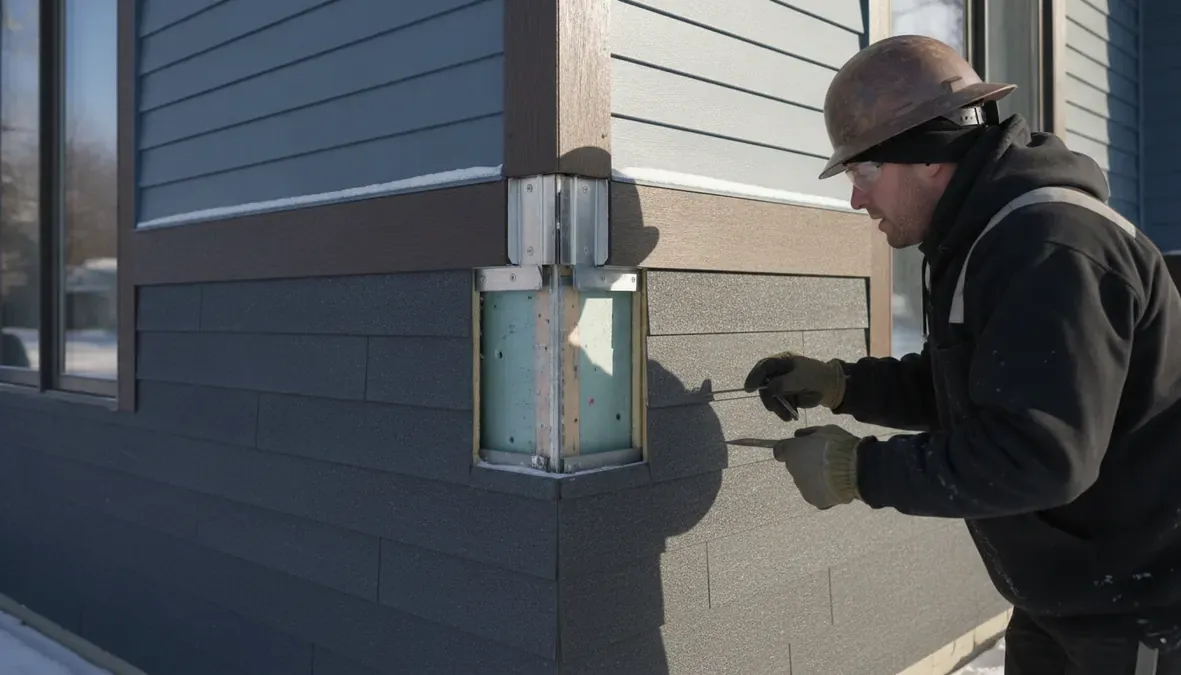
Fiber cement is often considered when a homeowner wants a heavier architectural appearance, strong fire resistance, and a surface that stands up well to normal weather exposure. It is not automatically the best answer for every house. The installer should first examine the sheathing, trim, flashing, and moisture conditions, then explain how the proposed system will handle Minnesota's snow, rain, and freeze-thaw movement.
If the project includes a product-specific comparison, our James Hardie siding installation guide covers a different fiber-cement question. This article stays focused on the vinyl versus fiber cement decision rather than repeating that installation overview.
Which siding has the lower installed cost?
Vinyl usually has the lower installed cost because the panels are lighter, easier to cut and handle, and typically require less finishing work. Fiber cement generally costs more at installation because the boards require more labor, specialized handling, careful joint treatment, and finish coordination. That is a useful direction for budgeting, but it is not a substitute for a project-specific estimate.
The most useful cost comparison is an apples-to-apples scope review. A low bid may exclude removal, disposal, housewrap, flashing, trim, soffit, fascia, window details, insulation, or repairs behind the old siding. A higher bid may include those items. Before comparing bids, ask whether both estimates cover:
Removal and disposal of the existing cladding.
Inspection and repair of sheathing or framing exposed during removal.
Housewrap or another water-resistive barrier and the required flashing.
Outside corners, inside corners, starter strips, trim, vents, and transitions.
Window and door integration, including head flashing and compatible sealants.
Insulation or exterior continuous insulation, if included in the energy plan.
Cleanup, workmanship coverage, and the material warranty documentation.
For a more detailed discussion of variables that affect a vinyl project, see the existing Minnesota vinyl siding cost guide. Its cost-planning advice is useful here, but fiber cement adds different labor and handling considerations. Minnesota Roofing Company uses an on-site review and written scope to account for the actual home rather than presenting a universal fiber-cement price that could mislead a homeowner.
Decision factor | Vinyl siding | Fiber cement siding |
Initial installed cost | Usually lower | Usually higher because of weight and labor |
Installation handling | Lightweight panels and faster handling | Heavier boards and more detailed cutting and fastening |
Routine maintenance | Cleaning and inspection; no routine repainting for the panels | Cleaning, caulk checks, and eventual finish maintenance |
Cold-weather consideration | Allow for movement and avoid impact on brittle panels | Plan installation and finishing around temperature requirements |
Best budgeting question | Is insulation and moisture protection included? | Is handling, finishing, and all trim labor included? |
Do not choose solely by the first number on a proposal. The lower-cost material can become a poor value if the installation leaves moisture pathways or if damaged panels are not repaired correctly. The higher-cost material can also disappoint when a contractor does not follow the system details.
Which material is more durable through Minnesota winters?
Fiber cement generally has the edge for a dense, impact-resistant exterior, while vinyl's performance depends heavily on panel quality, fastening, movement allowances, and protection from impact. Neither material is damage-proof. Hail, falling branches, snow and ice, poor drainage, and installation defects can affect any siding system.
Vinyl can move with temperature changes, which is expected. Problems arise when panels are nailed too tightly, trim is not detailed for movement, or a cold-weather impact cracks a panel. Replacement is often straightforward when matching material is available. Fiber cement does not have the same type of hollow-panel movement, but it can crack if mishandled or installed over an unstable substrate. Its joints, edges, paint, and caulk still need attention.
Moisture management is the deciding durability issue behind both materials. The siding is the outer cladding, not the only water barrier. A reliable system uses correctly lapped housewrap, flashing at openings and penetrations, drainage paths, and adequate clearance from roofs, decks, and grade. If a storm has already damaged the exterior, Minnesota Roofing Company's storm damage service information explains why documenting the full exterior matters before repairs begin.
Homeowners comparing the materials should also inspect the roof-to-wall transition, gutters, and downspouts. Overflowing or poorly directed water can shorten the life of new siding regardless of material. The company's gutter installation and protection services can be considered as part of a complete exterior water-management plan.
Which siding improves energy efficiency?
Siding alone is rarely the largest energy-efficiency lever. The wall assembly, air sealing, insulation levels, windows, attic insulation, and HVAC system usually matter more. Standard vinyl and standard fiber cement are cladding products, not substitutes for insulation. A siding replacement is an opportunity to inspect the wall and coordinate upgrades, but homeowners should ask exactly which energy improvements are included.
Insulated vinyl siding can add a layer of rigid foam backing and reduce some thermal bridging through the wall surface. It may improve comfort when used as part of a correctly designed wall assembly. Fiber cement can be installed over exterior insulation as well, but fiber cement itself should not be treated as a high-R-value product. In either case, the contractor needs to protect the water-resistive barrier, preserve drainage, and seal transitions around openings.
The same principle applies to the rest of the exterior system: a named product or certification matters only when the installer follows the product details. Our manufacturer certification and materials guide explains how homeowners can evaluate that connection without treating a credential as a substitute for a complete scope.
For a Minnesota home, the practical energy questions are:
Is the existing wall insulated, and is it dry enough to close back up?
Will the project include exterior continuous insulation or only new cladding?
How will the installer air-seal window, door, utility, and trim transitions?
Will adding thickness change window, gutter, roof-edge, or vent details?
Are attic insulation and air-sealing needs being addressed separately?
That is why an insulated-vinyl option may be the more direct siding-based energy choice, while a fiber-cement project can still be highly energy-conscious when paired with an appropriate exterior insulation and air-sealing plan. The material comparison should not promise a specific utility-bill reduction without an assessment of the home.
Our broader Minnesota siding replacement guide covers how material selection fits into a larger exterior project. If the roof is also being replaced, the metal roofing options page provides a separate look at an energy-related roofing decision. Siding and roofing should be detailed together at wall, eave, and flashing transitions, but one does not replace the other.
How do maintenance needs compare over time?
Vinyl is usually the simpler maintenance choice. Wash it as needed, inspect after major storms, and replace cracked or loose panels before water reaches the wall assembly. Avoid placing grills or other high-heat sources too close to the panels, and keep branches from scraping the surface. Color and texture choices affect how visible dirt and weathering become.
Fiber cement requires more finish awareness. Keep the surface clean, inspect joints and penetrations, and watch for chipped finish, open caulk joints, or areas where water can collect. Depending on the product and finish, repainting or touch-up may eventually be part of ownership. Its heavier construction does not eliminate the need to maintain flashing, trim, gutters, and roof edges.
In both cases, a maintenance plan should include a post-storm visual check. Do not power-wash aggressively, seal over suspected rot, or paint over a moisture problem without finding the source. A small defect in a panel may be cosmetic, while staining, soft sheathing, or recurring interior drafts can signal a larger wall issue.
Which choice is better for resale?
Resale value depends on the neighborhood, the home's price tier, the design, workmanship, buyer expectations, and the condition of the full exterior. Fiber cement can support a premium, substantial appearance and may appeal to buyers who value fire resistance and long-term durability. Vinyl can support strong resale appeal when it is clean, well-installed, visually appropriate for the home, and paired with a sound moisture-control system.
Neither product guarantees a return on investment. A buyer may value a documented installation, transferable material information, clean trim details, and evidence that the wall was dry before siding was installed more than a particular brand name. Minnesota Roofing Company's existing LP SmartSide and James Hardie comparison is a useful reminder that siding decisions should follow the home's priorities, not a one-size-fits-all winner.
How should you choose between vinyl and fiber cement?
For many Minnesota homeowners, vinyl is the practical choice when the project needs a lower initial cost, simple maintenance, light handling, and a broad range of styles. Fiber cement may be the better fit when the homeowner prioritizes a heavier architectural look, non-combustibility, and a dense exterior, and is prepared for higher installation labor and ongoing finish care.
Before signing a contract, ask the siding contractor to explain:
Why the recommended material fits the home's exposure, design, and ownership horizon.
What the existing siding is hiding, including moisture or sheathing damage.
Which housewrap, flashing, trim, and clearance details are included.
Whether insulation or air sealing is part of the scope or a separate option.
How winter temperatures affect the proposed installation schedule.
What maintenance, workmanship coverage, and manufacturer documentation you will receive.
A professional comparison should end with a written scope, not just a sample board. Minnesota Roofing Company can review the home's exterior, discuss vinyl and fiber cement options, and identify the details that will affect cost and long-term performance.
Frequently asked questions
Is vinyl or fiber cement better for Minnesota winters?
Neither is universally best. Fiber cement offers a denser, non-combustible exterior and strong weather resistance, while vinyl is lighter and usually less expensive. Vinyl needs proper movement allowances, and fiber cement needs careful handling, flashing, joints, and finish maintenance. The home's exposure and installation quality matter as much as the material.
Is fiber cement siding more expensive than vinyl siding?
Fiber cement is generally more expensive to install because it is heavier and requires more labor for handling, cutting, fastening, joints, and finishing. The exact difference depends on home design, removal, repairs, trim, insulation, and access. Compare written scopes instead of relying on a material-only price.
Does siding improve a Minnesota home's energy efficiency?
Siding can contribute to energy performance when it is paired with exterior insulation, air sealing, and correct flashing. Standard vinyl and fiber cement are primarily cladding materials, so neither should be treated as a replacement for wall or attic insulation. Ask whether energy upgrades are included in the siding proposal.
Which siding requires less maintenance?
Vinyl usually requires less finish maintenance because it does not normally need repainting. Fiber cement needs cleaning, caulk and joint inspections, and eventual finish maintenance depending on its product and exposure. Both materials need storm checks, clean gutters, sound flashing, and prompt attention to cracks or moisture.
Can Minnesota Roofing Company help compare siding materials?
Yes. Minnesota Roofing Company provides exterior remodeling and siding services across the Twin Cities area. A project review can consider the existing wall condition, moisture control, trim, insulation opportunities, material appearance, installation timing, and the homeowner's budget before a written scope is prepared.
For a siding decision that holds up in Minnesota, compare the full wall system and installation plan, not only the panel sample or starting price. The right choice is the one that fits the home's exposure, protects the wall assembly, and matches how you plan to maintain the property.


Comments